REVISTA INCLUSIONES – REVISTA DE HUMANIDADES Y CIENCIAS SOCIALES

ISSN 0719-4706
Volumen 13 Número 2
Abril - Junio 2026
e3767
https://doi.org/10.58210/rie3767
Fundamental Right to Health: Private Autonomy in Vaccine Refusal Versus Collective Health Protection in Brazil - Volumen 13 Número 2 - Página —-
| |
ISSN 0719-4706 | |
Fundamental Right to Health: Private Autonomy in Vaccine Refusal Versus Collective Health Protection in Brazil
/
Derecho fundamental a la salud: autonomía privada en la negativa a la vacunación frente a la protección colectiva de la salud en Brasil
/
Direito fundamental à saúde: autonomia privada na recusa vacinal versus proteção coletiva da saúde no Brasil
Fernanda Maria Policarpo Tonelli
Universidad Federal de São João del Rei, Brasil
ftonelli@ufsj.edu.br
https://orcid.org/0000-0002-2285-6710
Naony Sousa Costa Martins
Universidad Federal de Juiz de Fora, Brasil
naony.sousa@gmail.com
https://orcid.org/0000-0001-9005-1749
Flávia Cristina Policarpo Tonelli
Universidad Federal de São João del Rei, Brasil
flacristinaptonelli@gmail.com
https://orcid.org/0000-0002-4905-1701
Joice Cristina de Paula
Faculdade Anhanguera, Brasil
joicedipaula@hotmail.com
https://orcid.org/0000-0002-3099-4136
Fecha de Recepción: 20 de febrero de 2026
Fecha de Aceptación: 9 de marzo de 2026
Fecha de Publicación: 9 de abril de 2026
Financiamiento:
El autor declara que este estudio no recibió financiación externa.
Conflictos de interés:
El autor también declara no tener ningún conflicto de intereses.
Correspondencia:
Nombres y Apellidos: Fernanda Maria Policarpo Tonelli
Correo electrónico: ftonelli@ufsj.edu.br
Dirección postal: Rua Sebastião Gonçalves Coelho, 400 - Bairro Chanadour, Divinópolis - MG, 35501-296, Brasil
Los autores retienen los derechos de autor de este artículo. Revista Inclusiones publica esta obra bajo una licencia Creative Commons Atribución 4.0 Internacional (CC BY 4.0), que permite su uso, distribución y reproducción en cualquier medio, siempre que se cite apropiadamente a los autores originales.
https://creativecommons.org/licenses/by/4.0/
Abstract
Nowadays, vaccine refusal has become a growing challenge for public health, favoring the return of previously controlled diseases. The present scientific investigation aims to discuss the relevance of vaccination from the perspective of the collective right to health, in contrast to private autonomy and the citizen’s right to refuse vaccination. A critical legal-theoretical approach was carried out, along with comparative, interpretative, and systematic analyses of legal doctrine, constitutional provisions, infraconstitutional legislation, and case law. The importance of vaccination as a public health measure for both individual and collective protection, ensuring the realization of the fundamental right to health, was analyzed as well as the legal (im)possibility of vaccine refusal as an expression of private autonomy. In this context, the use of measures to encourage vaccination does not interfere with the citizen’s individual freedom provided that the principles of legality, necessity, proportionality, and respect for human dignity are observed.
Keywords: Private autonomy; Fundamental right to health; Vaccine refusal; Public health; Mandatory vaccination.
Resumen
En la actualidad, la negativa a la vacunación se ha convertido en un desafío creciente para la salud pública, favoreciendo el retorno de enfermedades anteriormente controladas. La presente investigación científica tiene como objetivo discutir la relevancia de la vacunación desde la perspectiva del derecho colectivo a la salud, en contraste con la autonomía privada y el derecho del ciudadano a rechazar la vacunación. Se llevó a cabo un enfoque crítico jurídico-teórico, junto con análisis comparativos, interpretativos y sistemáticos de la doctrina jurídica, las disposiciones constitucionales, la legislación infraconstitucional y la jurisprudencia. Se analizó la importancia de la vacunación como medida de salud pública para la protección individual y colectiva, garantizando la realización del derecho fundamental a la salud, así como la (im)posibilidad jurídica de la negativa a la vacunación como expresión de la autonomía privada. En este contexto, el uso de medidas para fomentar la vacunación no interfiere con la libertad individual del ciudadano, siempre que se respeten los principios de legalidad, necesidad, proporcionalidad y respeto a la dignidad humana.
Palabras clave: Autonomía privada; Derecho fundamental a la salud; Negativa a la vacunación; Salud pública; Vacunación obligatoria.
Resumo
Atualmente, a recusa vacinal tornou-se um desafio crescente para a saúde pública, favorecendo o retorno de doenças anteriormente controladas. A presente investigação científica tem como objetivo discutir a relevância da vacinação sob a perspectiva do direito coletivo à saúde, em contraste com a autonomia privada e o direito do cidadão de recusar a vacinação. Foi realizada uma abordagem crítica jurídico-teórica, juntamente com análises comparativas, interpretativas e sistemáticas da doutrina jurídica, das disposições constitucionais, da legislação infraconstitucional e da jurisprudência. Analisou-se a importância da vacinação como medida de saúde pública para a proteção individual e coletiva, assegurando a efetivação do direito fundamental à saúde, bem como a (im)possibilidade jurídica da recusa vacinal como expressão da autonomia privada. Nesse contexto, a adoção de medidas de incentivo à vacinação não interfere na liberdade individual do cidadão, desde que sejam observados os princípios da legalidade, da necessidade, da proporcionalidade e do respeito à dignidade da pessoa humana.
Palavras-chave: Autonomia privada; Direito fundamental à saúde; Recusa vacinal; Saúde pública; Vacinação obrigatória.
Introduction
Vaccination is a current topic of discussion and subject to various interpretations, especially in a post-Covid-19 pandemic context. In addition, in Brazil, there is a growing anti-vaccine movement. This context leads to important discussions regarding the conflict of rights when it comes to private autonomy and individual protection versus the protection of collective health and public interest. The discussion implies the need for legal analysis that respects the human dignity but also recognizes the State's duty to collective health (as per article 196 of the 1988 Brazilian Federal Constitution)[1], justifying this study.
This study is dedicated to analyzing the existing legal conflict between private autonomy, regarding the refusal of vaccination, and the fundamental collective right to health. To this end, it is necessary to examine the limits and possibilities of restrictions on individual freedom in the face of the protection of public health, based on the Federal Constitution and jurisprudence. Thus, the question is: to what extent can individual refusal of vaccination be legally limited by the need for collective health protection?
Aiming to systematize the study of the proposed research object, the research initially presents a brief history of vaccination and revisits the importance of vaccination for human health and effective protection against agents that cause potentially lethal diseases. Immediately following this, the research focuses on the study of the constitutional right to health as a modality of social rights. Based on these considerations, it becomes possible to discuss, from a legal standpoint, the (im)possibility of vaccine refusal in the face of private autonomy. It is noteworthy that the research uses several decisions of the Brazilian Supreme Federal Court, known as Supremo Tribunal Federal (STF), on the subject as theoretical support, to systematize a possible solution to the present legal conflict.
This study was developed through qualitative, legal-theoretical research, using the deductive method to analyze the existing conflict between private autonomy and collective health protection in the context of vaccination. The investigation was carried out based on a bibliographic review of national and foreign doctrine on fundamental rights, health, human rights, as well as the analysis of constitutional provisions and infra-constitutional legislation.
Jurisprudences that discuss the topic received attention to understand how the higher courts addressed the issue of mandatory vaccination, vaccination refusal, private autonomy, and public interest. The aim was to identify the legal foundations used in the decisions, as well as their compatibility with constitutional principles and public health policies.
1. A brief history of the vaccination
Vaccines are currently used to stimulate the body's defense mechanisms, aiming to protect those vaccinated against disease-causing agents. However, this idea of inducing the production of defense prior to the infection process is old. As early as the 15th century, there are reports of practices of this nature in countries such as China and Turkey[2], and there are references that argue that it emerged even earlier, in countries such as India[3].
The first attempts to develop vaccines aimed to protect individuals from the human smallpox virus; healthy people were exposed to scabs from lesions caused by the disease (obtained from patients) by inserting them into small cuts or through inhalation. The practice was known as variolation and caused a healthy individual to develop a less severe form of the disease (with a low chance of death), and after being cured, they would be protected against human smallpox[4]. The practice in question spread throughout the world and reached Europe and North America in the 18th century[5].
In that century, the disease was responsible for 400,000 deaths annually and for causing consequent blindness in 33% of the individuals who survived[6]. Especially among children, high death rates (of 80% or more) were common at the time, in cities like London and Berlin[7].
In this context, the physician and researcher Edward Jenner observed that people who worked collecting milk from cows and/or caring for the animals, and who had lesions caused by the cowpox virus, were immune to the virus that infected humans (smallpox). Given that infection with cowpox caused less risk to people than the infection with smallpox, Jenner used scabs from lesions on human skin caused by the first virus to generate protection against the second. As the Latin term for cow is vacca, this protective practice, initiated in 1796, became known as vaccination, and the applied content was referred to as vaccinia[8],[9].
However, there were problems associated with this form of inducing protection against diseases that motivated the continuation of research seeking alternative ways of prevention. A person exposed to material obtained from patients with cowpox, for example, often contracted other diseases that the patient had, such as syphilis and hepatitis[10].
In the 19th century, the scientist Louis Pasteur developed an attenuated vaccine to protect humans from the rabies virus[11]; individuals were exposed to the virus that causes the disease, but in a version with a reduced potential to cause severe symptoms, but capable of generating protection. These are first-generation vaccines: a classification that includes both vaccines that use the disease-causing agent in a weakened (attenuated) version and in a dead (inactivated) version[12].
Research has continued to this day to develop increasingly safe, effective, and efficient vaccines for the prevention of diseases caused by various types of agents. During the pandemic, for example, the rapid development of vaccines against the SARS-CoV-2 virus (coronavirus) was necessary, aiming to protect the population and reduce the number of cases, deaths, and complications of the disease worldwide.
1.1 The Importance of Vaccination
One of the ways the human body reacts to the presence of disease-causing agents is through a system known as the adaptive immune system (AIS), which develops a specific response against the agent to which the infected individual has been exposed. This system is able to store a memory of this defense that will be developed, and in a new exposure to the same agent, act more quickly to protect the body[13].
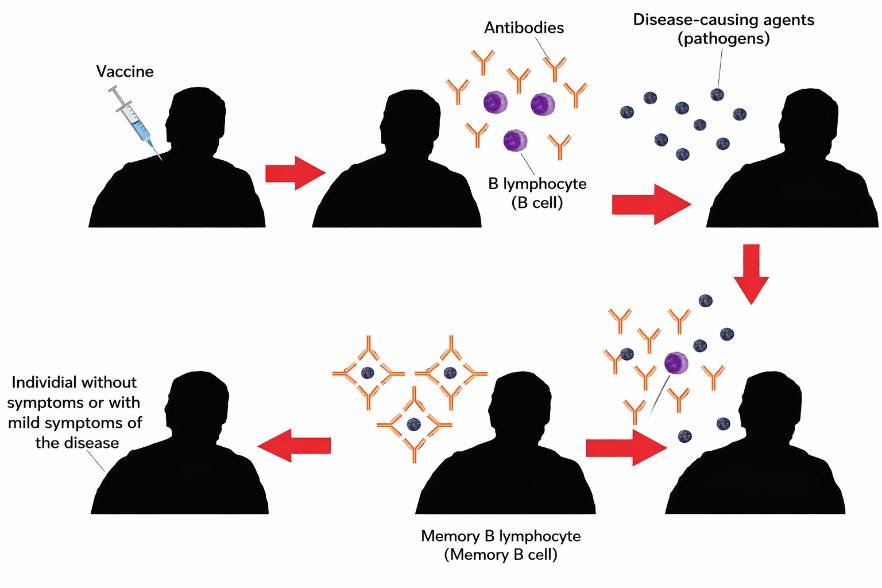
The AIS has very important cells for the body's defense, the lymphocytes. Some B lymphocytes can, when exposed to disease-causing agents, produce proteins with a protective function, called antibodies. Other B lymphocytes, called memory lymphocytes, are stored in structures distributed throughout the body (called lymph nodes) and, in case of future infection with the same agent, are responsible for the faster response of the immune system. This response prevents disease-causing agents from causing a severe form of the disease or even from causing the disease itself. Therefore, the vaccine induces the production of antibodies and the generation of memory B lymphocytes against a given disease-causing agent in the vaccinated individual. Subsequently, upon exposure to this agent, the individual can quickly develop a defense and avoid a severe form of the disease or even prevent the disease from developing, depending on the extent of protection offered by this vaccine (Figure 1).
Figure 1
The vaccine protects vaccinated individuals against diseases.
Source: The authors (2026).
To demonstrate the importance of vaccination in disease prevention, one can analyze the case of poliomyelitis, popularly known as infantile paralysis. This can be caused as a consequence of human infection by the WPV1, WPV2, and WPV3 viruses[14].
Individuals (adults or children) can become infected by coming into contact with oral secretions or feces from sick people; the most severe form of the disease can lead to paralysis in the lower limbs[15], severe cases of meningitis, and cause the death of those infected[16].
Thanks to vaccination, the transmission of the WPV3 virus in the world ceased in 2019 and that of WPV2 in 2015. WPV1 still circulates in the border region of Afghanistan with Pakistan, as the constant armed conflicts in the area hinder the vaccination of the population residing there[17]. The Salk (developed by Jonas Salk) and Sabin (developed by Albert Sabin) vaccines from the 20th century can be used for prevention. Brazil uses the second type, which is in drops, and consists of an attenuated viral form[18].
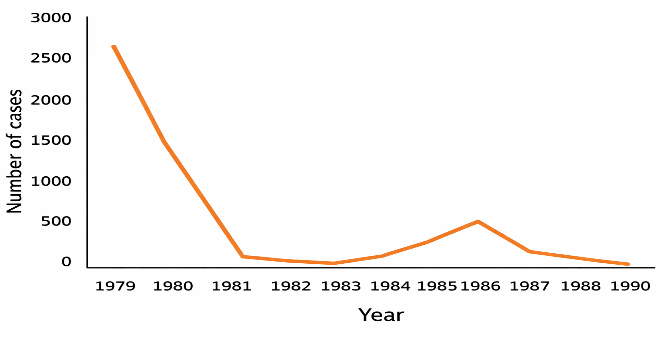
The disease has existed since antiquity, but poliomyelitis had its first reported outbreak in Brazil in 1911. In 1986, Brazil intensified vaccination efforts through a Working Group for this purpose, to achieve success in the endeavor with the last diagnosis of infection by the virus in 1989[19] (Figure 2).
Figure 2
Temporal evolution of confirmed cases of poliomyelitis in Brazil from 1979 to 1990
Source: The authors (2026), using numerical data from the work of Durante and Poz, 2014.
In the global scenario, the number of reported cases decreased from over 80,000 in 1955 to less than 1,000 in 2021[20]. It is estimated that since 1988, health systems have saved $27 billion in costs related to polio-related care[21].
In a global context, the World Health Organization launched the expanded immunization program in 1974. In its 50 years of existence, thanks to vaccines against diphtheria, hepatitis B, meningitis A, rotavirus, polio, rubella, tetanus, tuberculosis, yellow fever, pertussis, measles, Haemophilus influenzae type B, Japanese encephalitis, and invasive pneumococcal disease, 154 million deaths have been avoided. Of these, 1.57 million would have been caused by polio, and more than 94% of the 154 million deaths would have been children under 5 years old[22]. Therefore, vaccines are crucial for human life.
However, countries like Brazil are currently facing a decline in vaccination rates. One of the reasons is related to the effects of the pandemic, which culminated in dedicated efforts to combat coronavirus, resulting in less attention to vaccination campaigns and the prevention of other diseases. In addition to this, other relevant reasons are fake news and anti-vaccine movements, which discourage the population from getting vaccinated[23],[24].
As a consequence, the country faces the risk of the return of polio as a result of this decline in vaccination coverage. The goal for the country to be considered protected against the disease is equivalent to vaccinating 95% of the target population. In 2021, only 67% of the target population was immunized with the three initial doses of the vaccine. As for booster doses in drops, only 52% of children were vaccinated[25]. The country, which received a certificate from the Pan American Health Organization (PAHO) in 1994 for eliminating the transmission of the virus, is at high risk of dealing with the disease again, which in its most severe form can cause paralysis of the legs in children (preventing them from walking) and even death (due to paralysis of the respiratory muscles)[26].
2. The Fundamental Right to Health and its Constitutional Provision in Brazil
The aim of this research topic is to propose considerations regarding the fundamental right to health. As defined by Uadi Lammêgo Bulos, “health is the state of complete physical, mental and spiritual well-being of man, and not merely the absence of disease or infirmity” [27]. The 1988 Federal Constitution was the first Brazilian constitution to typify the right to health as a fundamental right. This right has a social character, according to a systematic analysis of Article 6 of the Federal Constitution, which states in a free translation: “The following are social rights: education, health, food, work, housing, transportation, leisure, security, social security, protection of motherhood and childhood, and assistance to the destitute, in the manner of this Constitution”[28].
As highlighted by Ingo Wolfgang Sarlet and Mariana Filchtiner Figueiredo, one of the characteristics that demarcate the 1988 Federal Constitution is the positivization of the fundamental right to health, based on the democratic-constitutional constitutionalism of the post-war period. Thus, in a free translation, the "constitutional protection existing in the country before 1988 was limited to scattered norms, such as the guarantee of 'public assistance' and the guarantee of the inviolability of the right to subsistence"[29].
Article 196 of the Federal Constitution[30], the first one of a section of the text dedicated to health, states that the State has the duty to safeguard the right to health, which belongs to everyone. In a free translation:
“Health is a right of all and a duty of the State, guaranteed through social and economic policies aimed at reducing the risk of disease and other health problems, and ensuring universal and equal access to actions and services for its promotion, protection, and recovery”.
It is important to mention that health is located within the chapter dedicated to social security, constituting one of its three pillars.
In addition to the constitutional provision, in the list of fundamental rights, health is also a human right. The present research aligns with the doctrine that understands fundamental rights to be distinct from human rights. In this sense, Valério Mazzuoli points out[31], in a free translation:
“In common language, however, the expression “human rights” is frequently used to also refer to the protection that the internal legal order (especially the Constitution) grants to those who are subject to the jurisdiction of a particular State. In technical terms, however, such a reference is not correct, and the expression “human rights” should only be used when dealing with the international protection of such rights. In fact, it is known that the legal protection of people's rights can come from or arise from the internal (state) order or the international order (international society). When the former protects the rights of a citizen, we are dealing with the protection of a fundamental right of the person; when the latter protects that same right, we are dealing with the protection of a human right of that person [...]. Therefore, human rights have a broader content than fundamental rights, because they come from the international order and not from domestic law, as well as because they also reflect the consent of States to protect and safeguard rights beyond their respective domestic orders”.
When it comes to health, the Article 25 of the Universal Declaration of Human Rights of the United Nations General Assembly of 1948[32] presents the idea that:
“1.Everyone has the right to a standard of living adequate for the health and well-being of himself and of his family, including foods, clothing, housing and medical care and necessary social services, and the right to security in the event of unemployment, sickness, disability, widowhood, old age or other lack of livelihood in circumstances beyond his control.
2.Motherhood and childhood are entitled to special care and assistance. All children, whether born in or out of wedlock, shall enjoy the same social protection”.
The cited text predates the 1988 Federal Constitution and already foresaw the idea of establishing a dignified standard of living for the individual, including, from this perspective, the right to health, the understanding of which encompasses the well-being of the individual and their family. Thus, the right to health has been recognized as essential for a dignified human existence, in view of the principle of the human dignity.
Therefore, to make it effective, Brazil has a unified system, mentioned in article 198 of the Federal Constitution. This article states that public health actions and services are part of this system, which has as its guidelines decentralization, comprehensive care, with priority given to preventive activities and community participation1. It is also important to mention that access to health in Brazil is based on the principle of universality, that is, Brazilians and foreigners residing in the country. The Unified Health System (in Portuguese SUS) is financed in Brazil through public funds, with private institutions allowed complementary participation, obeying previously established guidelines. Article 200[33] of the Brazilian Federal Constitution of 1988 states that, in a free translation:
“The Unified Health System is responsible for, among other duties, as defined by law: I - controlling and monitoring procedures, products and substances of interest to health and participating in the production of medicines, equipment, immunobiologicals, blood products and other supplies; II - carrying out sanitary and epidemiological surveillance actions, as well as those related to worker health; III - organizing the training of human resources in the health field; IV - participating in the formulation of policy and the execution of basic sanitation actions; V - promoting, in its area of operation, scientific and technological development and innovation; VI - monitoring and inspecting food, including the control of its nutritional content, as well as beverages and water for human consumption; VII - participating in the control and monitoring of the production, transport, storage and use of psychoactive, toxic and radioactive substances and products; VIII - collaborating in the protection of the environment, including the work environment”.
To regulate "the promotion, protection and recovery of health, the organization and functioning of the corresponding services" associated with this unified system, Law No. 8,080 was enacted in 1990, reinforcing the idea that the formulation of immunobiological policy (a category that includes vaccines) falls within the scope of the SUS's field of action[34].
The Brazilian National Immunization Program, created in 1973 and institutionalized in 1975, is one of the most comprehensive in the world, providing vaccines to the population free of charge[35]. Currently, more than 30 vaccines are available in the country[36]. Despite the scope of the Brazilian system, there is still resistance from some citizens regarding the autonomy to vaccinate or not. This issue will be analyzed in the next section of the research on private autonomy versus collective protection of the right to health.
3. Vaccine refusal: an analysis from the perspective of private autonomy versus the collective right to health
The objective of this research topic is to present a legal analysis of the (im)possibility of vaccine refusal in the face of private autonomy versus the fundamental collective right to health. Therefore, the aim is to determine which of the rights listed here should prevail in a specific case, based on the principles of reasonableness and proportionality. The philosopher Immanuel Kant[37] considered that (in a free translation):
“Willpower is a kind of causality in living beings, insofar as they are rational, and freedom would be the property of this causality, by which it can be efficient, independently of external causes that determine it”.
Therefore, for the autonomy of the will to manifest itself, freedom is necessary: "The concept of freedom is the key to explaining the autonomy of the will"[38]. This "autonomy of the will is that property by which it is its own law (regardless of the nature of the objects of desire)"[39].
Thus, for this autonomy to be exercised, rationality is necessary on the part of the individual who is fully capable of, possessing the information and facing the facts, choosing how to act and bearing responsibility for their actions[40]. However, there is a limit to the exercise of this autonomy: one cannot infringe on the rights of others or legal precepts. With regard to health, the Medical Code of Ethics states in the text "CONSIDERING the pursuit of a better relationship with the patient and the guarantee of greater autonomy to their will"; however, in Chapter I (Fundamental Principles), article XXI, a limit is established for this patient’s autonomy (in a free translation and presenting emphasis added by the authors)[41]:
“In the process of making professional decisions, in accordance with their conscience and legal provisions, physicians will accept their patients' choices regarding diagnostic and therapeutic procedures, provided they are appropriate to the case and scientifically recognized”.
Regarding vaccines for children, the autonomy of the will of those responsible is limited by the duty of responsibility of parents towards their children, and regarding adults, for collective health.
In the first scenario, forming a family is a choice of each individual, but once it is formed, in the existence of children, the parents hold parental authority or family power: having the duty to ensure that the rights of these minor children are fulfilled[42]. With regard to children, the Statute of the Child and Adolescent, special legislation dedicated to safeguarding their rights, provides in its Article 14, § 1 that "Vaccination of children is mandatory in cases recommended by health authorities". Failure to vaccinate children may result in the application of a fine to the parents[43]; in a free translation:
“Art. 249. Willfully or negligently failing to fulfill the duties inherent to parental authority or arising from guardianship or custody, as well as a determination by the judicial authority or the Guardianship Council:
Penalty - a fine of three to twenty reference salaries, doubled in case of recidivism”.
In the case of adults, mandatory vaccination is a function of collective health, as occurred during the pandemic caused by coronavirus. In this scenario, mandatory vaccination was necessary to contain the spread of the disease. The public interest in cases like this overrides the private interest.
Celso Antônio Bandeira de Mello defines, in a free translation, public interest as "the interest resulting from the set of interests that individuals personally have when considered in their capacity as members of society and simply by virtue of being so". Collective health, in turn, has its objective "constructed within the limits of the biological and the social and includes the investigation of the determinants of the social production of diseases and the organization of health services, and the study of the historicity of knowledge and practices about them"[44].
In 1837, in Brazil, the smallpox vaccine was the first to become mandatory to solve the public health problem experienced at the time. However, with the enactment of Law No. 1,261, of October 31, 1904,[45] part of the population did not peacefully accept this mandatory measure. At the time, for example, there were rumors that getting vaccinated would result in the appearance of bovine features: a scenario similar to the fake news regarding Covid-19 vaccines. The population's response at the beginning of the 20th century was revolt (the Vaccine Revolt), causing the death of 30 people in Rio de Janeiro (at the time the capital of the country), in addition to 110 injured and 945 arrests. The law was repealed and the disease continued to claim victims, until a peak of infections in 1908 (6,500 cases) motivated people to voluntarily go to health centers to be vaccinated[46].
Regarding the coronavirus vaccine, given the rapid spread of the disease and the associated lethality, mandatory vaccination was determined in the country. Even before the Federal Constitution, the possibility of mandatory vaccinations, not only for children, has been established in legislation. Law No. 6,259 of 1975, for example, states in its text, in a free translation (emphasis added by the authors)[47]:
“Art 3th It is the responsibility of the Ministry of Health to develop the National Immunization Program, which will define the vaccinations, including those of a mandatory nature.
Sole paragraph. Mandatory vaccinations will be carried out systematically and free of charge by public bodies and entities, as well as by private entities subsidized by the Federal, State and Municipal Governments, throughout the national territory”.
During the pandemic, through Law No. 13,979 of 2020[48], modified by Law No. 14,035[49], it was determined that it would be possible, to address the global health emergency, to mandate compulsory vaccination against the SARS-CoV-2 virus. In a free translation:
“Art. 3th To address the public health emergency of international concern covered by this Law, the authorities may adopt, within their respective competences, among other measures, the following:
I - isolation;
II - quarantine;
III - mandatory determination of:
a) medical examinations;
b) laboratory tests;
c) collection of clinical samples;
d) vaccination and other prophylactic measures”…
It is noteworthy that not only the legal text, but also jurisprudence considers that the autonomy of will in relation to the choice of whether to vaccinate, has as its main limitation collective health. Mass vaccination of the population to prevent the spread of diseases benefits not only the immunized person, protecting them, but also those in society whose immune system is not functioning so well (the immunosuppressed, such as transplant recipients and chemotherapy patients, for example) and those who have not yet reached the minimum age to receive a particular vaccine. Achieving so-called "herd immunity" brings benefits not only to those vaccinated, but also to the entire community. It offers sanitary security to the population[50]. The following topic analyzes decisions of the STF on the subject.
4. Analysis of the Brazilian Supreme Federal Court's decisions on vaccination
On the STF website, in the tab dedicated to jurisprudence research (https://jurisprudencia.stf.jus.br/pages/search), when a search was conducted on August 8, 2025, for "mandatory immunization" in the rulings, a decision was found regarding Extraordinary Appeal with Aggravation (in Portuguese ARE) No. 1,267,879[51].
In the search for "mandatory" and "vaccination" (to obtain results with the simultaneous occurrence of both terms) 7 results were obtained: Direct Action of Unconstitutionality (in Portuguese ADI) No. 2,110, ADI No. 6,586, ARE No. 1,267,879, Argument of Non-Compliance with Fundamental Precept (in Portuguese ADPF) No. 946, ADPF No. 1,123, ADPF No. 754, Representation (in Portuguese Rp) No. 945[52].
Rp No. 945 did not directly address the issue, but rather a conflict of jurisdictions. This is a representation from the Attorney General of the Republic (prompted by the Minister of Health), with the Legislative Assembly of the State of São Paulo as the represented party, judged on December 17, 1975. The constitutionality of state law no. 863 of December 11, 1975, was questioned. This law required proof of immunization against meningitis for “enrollment in educational establishments, admission to public service, obtaining an identity card and a certificate of criminal record”[53]. Minister Cunha Peixoto, the rapporteur, provisionally suspended the application of the law, considering that, for the rapid vaccination against the disease, aimed at containing the epidemic, the SUS had not been concerned with providing proof of vaccination; therefore, the entry into force of the law would cause harm to the population. Article 6 of Law No. 6,259 of 1975 (in a free translation)[54]:
“State governments, after consulting with the Ministry of Health, may propose supplementary legislative measures aimed at ensuring compliance with mandatory vaccinations for the population within their territories”.
Therefore, on April 12, 1978, by decision in plenary session, the Supreme Federal Court recognized the absence of a hearing on the matter by the state before the drafting of the state law, thus lacking the competence to legislate on the matter. Consequently, the law was declared unconstitutional.
In 2020, however, in the context of the Covid-19 pandemic, the issue of mandatory vaccination came to the forefront. On August 27, 2020, mandatory vaccination was addressed in ARE No. 1,267,879 (under the rapporteurship of Minister Barroso) and deemed constitutional. In addition, the existence of general repercussions of the issue was recognized (Theme 1,103). On December 17 of the same year, the court then considered the merits of the issue[55]. In a free translation:
“The Court, unanimously, considering topic 1.103 of general repercussion, denied the extraordinary appeal, in accordance with the Rapporteur's vote. The following thesis was established: "The mandatory immunization through a vaccine that, registered with a health surveillance agency, (i) has been included in the National Immunization Program or (ii) has its mandatory application determined by law or (iii) is the subject of a determination by the Union, State, Federal District or Municipality, based on medical-scientific consensus, is constitutional. In such cases, there is no violation of the freedom of conscience and philosophical conviction of parents or guardians, nor of parental authority".
On this same date, ADI No. 6,586, reported by Minister Lewandowski and authored by the Partido Democrático Trabalhista, was judged jointly with ADI No. 6,587 (proposed by the Partido Trabalhista Brasileiro). The first aimed to provide a conforming interpretation to article 3, caput, III, "d", of Law 13,979/2020 to leave it to States and Municipalities to determine the compulsory implementation of vaccination; the second aimed to challenge the aforementioned subparagraph. In the rapporteur's vote, it was stated that, in a free translation[56]:
“(I) Compulsory vaccination does not mean forced vaccination, as the user is always entitled to refuse, but it may be implemented through indirect measures, which include, among others, restrictions on the exercise of certain activities or attendance at certain places, provided that they are provided for by law, or derived from it, and (i) are based on scientific evidence and relevant strategic analyses, (ii) are accompanied by comprehensive information on the efficacy, safety and contraindications of the immunizing agents, (iii) respect human dignity and the fundamental rights of individuals, (iv) meet the criteria of reasonableness and proportionality, and (v) the vaccines are distributed universally and free of charge; and (II) such measures, with the limitations set out above, may be implemented by the Union as well as by the States, the Federal District and Municipalities, respecting their respective spheres of competence”.
On March 21, 2022, ADPF No. 754 was judged, with Minister Lewandowski as the rapporteur. It concerned a request for urgent relief filed by Rede Sustentabilidade against actions by the Federal Government, particularly through the Ministries of Health and of Women, Family and Human Rights, which were contrary to the Covid-19 vaccination policy. The Decision, in a free translation, stated the following[57]:
“The Court, unanimously, ratified the requested precautionary measure to order the Ministry of Health and the Ministry of Women, Family and Human Rights to include, as soon as they are notified of this decision, in Technical Notes 2/2022-SECOVID/GAB/SECOVID/MS and 1/2022/COLIB/CGEDH/SNPG/MMFDH, the interpretation given by the Supreme Federal Court to art. 3°, III, d, of Law 13,979/2020, in the sense that (i) “compulsory vaccination does not mean forced vaccination, as it always requires the user's consent, but may be implemented through indirect measures, which include, among others, restrictions on the exercise of certain activities or the attendance at certain places, provided that they are provided for by law, or arising therefrom”, further clarifying that (ii) “such measures, with the limitations set forth, may be implemented by the Union as well as by the States, the Federal District and Municipalities, respecting their respective spheres of competence”, giving wide publicity to the rectification now imposed, also endorsing the determination to the Federal Government to refrain from using the “Dial 100” complaint channel outside of its institutional purposes, ceasing to encourage, through official acts, the sending of complaints related to restrictions on rights considered legitimate by this Supreme Court in the judgment of ADIs 6.586/DF and 6.587/DF and of ARE 1.267.879/SP, in accordance with the Rapporteur's vote”.
Recently, on March 11, 2024, ADPF No. 1,123 (proposed by Partido Socialismo e Liberdade (PSOL)) was judged, with Minister Zanin as the reporting judge. This aimed to provide legal support so that, once the Covid-19 vaccine is included in the National Immunization Plan (PNI), it cannot be considered non-mandatory by municipal public authorities. The court's decision, in a free translation, by majority vote[58]:
… “ratified the decision that partially granted the precautionary measure, suspending the effects of the municipal decrees indicated in this decision that waived the requirement of a Covid-19 vaccine for enrollment and re-enrollment in the public education system, according to the vote of the Rapporteur, with Ministers André Mendonça and Nunes Marques dissenting, who would have partially granted the precautionary measure, interpreting the questioned municipal decrees in accordance with the Constitution”.
On March 21, 2024, ADI No. 2,110, reported by Minister Nunes Marques, was judged, reaffirming the constitutionality of the requirements for presenting proof of school attendance and mandatory vaccination for the granting of family allowance[59].
On November 6, 2024, ADPF No. 946 (reported by Minister Barroso) was judged with a request for precautionary measures by Rede Sustentabilidade, since a municipal law of Uberlândia-MG prohibited compulsory vaccination against Covid-19 throughout the municipal territory and prohibited the application of restrictions and sanctions against unvaccinated people, including public agents and servants. The Plenary reaffirmed that the determination of compulsory vaccination is constitutional, as addressed in the context of ADI No. 6,586[60] (in a free translation):
“There is medical and scientific consensus regarding the importance of vaccination in reducing the risk of Covid-19 infection, as well as in increasing the resistance capacity of people who become infected. By prohibiting the imposition of restrictions on unvaccinated people, the law discourages adherence to immunization, generating a risk to public health”…
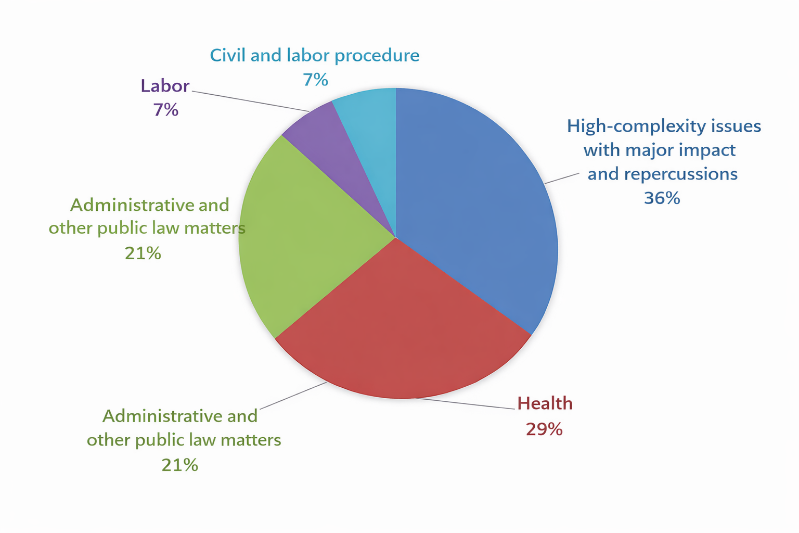
Regarding vaccination and the pandemic, in the STF's statistical panel, under the category "Covid-19 Actions," as of August 8, 2025, there were 11,894 cases and 16,201 decisions listed. Filtering by "Vaccine" yielded 14 cases and 57 decisions, as shown in Figure 3.
Figure 3
Thematic areas of cases related to vaccines and the pandemic in which the Supreme Federal Court (STF) issued rulings.
Source: The authors (2026).
These results, in addition to the decisions already mentioned, include others such as the Original Civil Actions (in Portuguese ACOs) No. 3,451, 3,458 and 3,463, the ADPFs No. 756, 829, 846, the Habeas Corpus No. 195,045, the Claims (Rcls) No. 45,469, 46,843, 47,311, 48,385 and the Writ of Mandamus No. 38,042[61].
ACO No. 3,463 dealt with a discussion between the State of São Paulo and the Union regarding needles and syringes for vaccination; ACO No. 3,458 addressed the budgetary and financial balance of this state to implement the state vaccination plan against Covid-19; ACO No. 3,451 concerned a claim by the state of Maranhão to import the Sputnik V vaccine (authorization that was granted)[62].
ADPF No. 756 involved a request for urgent protection by Cidadania, Partido Comunista do Brasil , Partido dos Trabalhadores, Partido Socialista Brasileiro and PSOL so that not only adolescents aged 12 to 17 with permanent disabilities, comorbidities or who were deprived of liberty could have access to the Covid-19 vaccine. Under the rapporteurship of Minister Zanin, it was decided that (in a free translation)[63]:
“In light of the foregoing, based on the reasons explained above, I partially grant the injunction, subject to ratification by the Plenary of the Supreme Federal Court, to establish that the decision to promote the immunization of adolescents over 12 years of age falls within the competence of the States, the Federal District, and the Municipalities, considering the specific situations they may face, always under their exclusive responsibility, and provided that the precautions and recommendations of the vaccine manufacturers, ANVISA, and medical authorities are observed, respecting also the order of priorities contained in Technical Note 36/2021-SECOVID/GAB/SECOVID/MS, of 2/9/2021”.
Regarding ADPF No. 829, the precautionary request was not considered (it proceeded to the instruction phase), and regarding No. 846, it was dismissed without prejudice due to the lack of the legal requirement of subsidiarity[64].
HC No. 195,045 was a "preventive" HC to protect the rights and freedoms of the Brazilian people or inhabitants of the national territory, so that they are not obliged to vaccinate (against coronavirus) with an immunizing agent that has not developed/completed its phase IV of clinical trials. Minister Alexandre de Moraes dismissed it based on article 21, §1, of the Internal Regulations of the STF[65]:
The Rapporteur may deny further processing of a manifestly inadmissible, unfounded, or contrary to the prevailing jurisprudence or precedent of the Court's decision, dismiss it in cases of manifest incompetence, forwarding the case file to the body deemed competent, as well as summarily quash or amend a judgment contrary to the established guidelines under Article 543-B of the Code of Civil Procedure.
The aforementioned Writ of Mandamus referred to the breach of telephone, tax, and banking secrecy determined by the Parliamentary Commission of Inquiry (CPI) of the Pandemic[66].
Rcls No. 48385 and 45469 were denied follow-up; they addressed, respectively, the absence of provision in the PNI for vaccination against Covid-19 of a patient with comorbidities, a minor, with the Pfizer vaccine, and the lack of reservation of doses of the “CoronaVac” vaccine for the municipality of Barra do Piraí/RJ. Rcl No. 47311 had its protection granted against a municipal law of Esteio/RS that included teachers in the preferential vaccination group; it was determined that the guidelines of the National Operational Plan for vaccination against Covid-19 should be observed. Regarding Rcl No. 46,843, a similar position was adopted, suspending the decision that included professionals and workers of the Public Security and Rescue Forces of the State of Goiás in a priority group for immunization[67].
According to recent data from the WHO, UNICEF and PAHO, there has been a reduction in vaccination in Brazil and a stagnation of childhood vaccination since 2023. The application of important vaccines for children, such as those against diphtheria, tetanus, measles and pertussis, has decreased. It is observed that cases of low vaccination coverage mostly occur in countries in vulnerable situations. Therefore, the development of health policies and the exercise of the right to health, including vaccination, is a public necessity not only nationally, but globally[68].
Conclusions
The research conducted demonstrates that the fundamental right to health has both an individual and a collective perspective, leaving no doubt that it is the State's duty to promote it through efficient public policies, such as vaccination programs. Private autonomy, constitutionally protected as an expression of human dignity, cannot, however, be exercised absolutely when it conflicts with the fundamental rights of third parties and the protection of the community.
Refusing to vaccinate, from the perspective of autonomy, faces legal limits when this fact impacts collective rights and puts public health at risk, especially in more severe contexts, such as outbreaks, pandemics, and epidemics. As per the understandings presented throughout the article, compulsory vaccination is legitimate, provided that legality, necessity, proportionality, and respect for human dignity are observed. Therefore, the use of measures to encourage vaccination does not interfere with individual freedom specifically, as there is a greater good for the community, according to legislation and jurisprudential understanding.
Therefore, it is necessary to strike a balance between the exercise of individual autonomy and collective protection in a proportionate manner. The State, by acting coercively and proposing measures for mandatory vaccination, does not negate autonomy, but rather conditions it on the prevalence of the public interest, in accordance with constitutional principles. Vaccination, in this context, should be understood not only as an individual right, but also as a social duty, essential to the realization of the collective right to health.
Bibliography
Badizadegan, Kamran, Kalkowska, Dominika A., y Thompson, Kimberly M. “Polio by the Numbers-A Global Perspective”. The Journal of Infectious Diseases v. 226, no. 8 (2022): 1309-1318. https://doi.org/10.1093/infdis/jiac130.
Barquet, Nicolau, y Domingo, Pere. “Smallpox: the triumph over the most terrible of the ministers of death”. Annals of Internal Medicine 127, no. 8 (1997): 635–642. https://doi.org/10.7326/0003-4819-127-8_part_1-199710150-00010.
Biernath, André, Como Brasil entrou em lista de 'alto risco' de volta da pólio (São Paulo: BBC News Brasil, 2021). https://www.bbc.com/portuguese/brasil-59646001.
Brasil. Lei No. 1,261. Diário Oficial da União, october 31st 1904. https://www2.camara.leg.br/legin/fed/lei/1900-1909/lei-1261-31-outubro-1904-584180-publicacaooriginal-106938-pl.html.
Brasil. Lei No. 6,259. Diário Oficial da União, october 30th 1975. https://www.planalto.gov.br/ccivil_03/leis/l6259.htm.
Brasil. Constituição da República Federativa do Brasil. Diário Oficial da União, october 05th 1988. https://www.planalto. gov.br/ccivil_03/Constituicao/Constituicao.htm.
Brasil. Lei No. 8,080. Diário Oficial da União, september 19th 1990. https://www.planalto.gov.br/ccivil_03/LEIS/L8080.htm.
Brasil. Lei No. 8,069. Diário Oficial da União, july 13th 1990. https://www.planalto.gov.br/ccivil_03/leis/L8069.htm.
Brasil. Lei No. 13,979. Diário Oficial da União, february 06th 2020. https://www.planalto.gov.br/ccivil_03/%5C_ato2019-2022/2020/Lei/L13979.htm#view.
Brasil. Lei No. 14,035. Diário Oficial da União, august 11th 2020. https://www.planalto.gov.br/ccivil_03/_ato2019-2022/2020/lei/l14035.htm.
BULOS, Uadi Lammêgo. Curso de Direito Constitucional. São Paulo: Saraiva, 2017.
CFM. Código de Ética Médica: Resolução CFM No. 2,217, de 27 de setembro de 2018 (Brasília: Conselho Federal de Medicina, 2019), https://portal.cfm.org.br/images/PDF/cem2019.pdf.
Clem, Angela S. “Fundamentals of vaccine immunology”. Journal of Global Infectious Diseases 3, no. 1 (2011): 73-78. https://doi.org/10.4103/0974-777X.77299.
Dandara, Luana, Pesquisadores da Fiocruz alertam para risco de retorno da poliomielite no Brasil (Rio de Janeiro: Fiocruz, 2022). https://portal. fiocruz.br/noticia/pesquisadores-da-fiocruz-alertam-para-risco-de-retorno-da-poliomielite-no-brasil.
Dantas, Juliana de Oliveira Jota, y Silvestre, Luciano Soares. “O tratamento da Covid-19 e a autonomia da vontade do paciente: entre a liberdade individual e o interesse coletivo”. Revista dos Estudantes de Direito da Universidade de Brasília 21 (2022): 280-304. https://periodicos.unb.br/index.php/redunb/article/view/42433.
De Mello, Celso Antônio Bandeira. Curso de Direito Administrativo. São Paulo: Malheiros, 2008.
Durante, Ana Luísa Teixeira da Costa, y Dal Poz, Mario Roberto. “Saúde global e responsabilidade sanitária brasileira: o caso da erradicação da poliomielite”. Saúde Debate v. 38 (2014): 1-11. https://www.redalyc.org/pdf/4063/406341754013.pdf.
Fiocruz. Ministério da Saúde divulga o Calendário Nacional de Vacinação 2024. Rio de Janeiro: Fiocruz, 2024. https://portal.fiocruz.br/noticia/mi nisterio-da-saude-divulga-o-calendario-nacional-de-vacinacao-2024.
Fujita, Dennis Minoru, Cruz, Tamara Cristina Gomes da, Ferreira, Elaine Moura, y Nali, Luiz Henrique da Silva. “The continuous decrease in Poliomyelitis vaccine coverage in Brazil”. Travel Medicine and Infectious Disease v. 48 (2022): 102352. https://doi.org/10.1016/j.tmaid.2022.102352.
Henderson, Donald A, y Moss, Bernard. “Smallpox and Vaccinia”. En Vaccines, editado por Plotkin, Stanley A, y Orenstein, Walter A., 161-193. Philadelphia: Saunders, 1999. https://www.ncbi.nlm.nih.gov/books/NBK7294/.
Kant, Immanuel. “Fundamentação da metafísica dos costumes”. En Crítica da razão pura e outros textos filosóficos. Col. Os pensadores. São Paulo: São Paulo, 1974.
Lahariya, Chandrakanthi. “A brief history of vaccines & vaccination in India”. Indian Journal of Medical Research 139, no. 4 (2014): 491-511. https://pmc.ncbi.nlm.nih.gov/articles/PMC4078488/.
Lamy, Marcelo, Abud, Carol de Oliveira, y Ferreira, Marchione dos Reis. “Vacinação infantil: autonomia da vontade x dever familiar”. Anais do VIII Encontro Nacional de Pós-Graduação 3, no. 1 (2019): 510-514. https://periodicos.unisanta.br/ENPG/article/view/1737.
Louten, Jennifer. “Poxviruses”. En Essential Human Virology, editado por Louten, Jennifer., 323-340. Nova Iorque: Academic Press, 2023. https://doi.org/10.1016/B978-0-12-800947-5.00015-6.
Margolick, Joseph B., Markham, Richard B., y Scott, Alan L. “The immune system and host defense against infections”. En Infectious Disease Epidemiology: Theory and Practice, editado por Nelson, Kenrad E., y Williams, Carolyn Masters., 317-343. Boston: Jones and Bartlett, 2006. https://oncohemakey.com/the-immune-system-and-host-defense-against-infections/.
Mazzuoli, Valerio de O. Curso de Direitos Humanos. Rio de Janeiro: Método, 2024. https://integrada. minhabiblioteca.com.br/reader/books/9788530994358/.
Miller, Genevieve. “Putting Lady Mary in her place: A discussion of historical causation”. Bulletin of the History of Medicine 55, no. 1 (1981): 2-16. https://www.jstor.org/stable/44442967.
Ministério da Saúde do Brasil. “Poliomielite”. Accessed on august 08th 2025. https://www.gov.br/saude/pt-br/assuntos/saude-de-a-a-z/p/poliomielite
Ministério da Saúde do Brasil. “Programa Nacional de Imunizações – Vacinação”. Access on august 08th 2025. https://www.gov.br/saude/pt-br/acesso-a-informacao/acoes-e-programas/pni.
Natesan, Krithiga, Isloor, Shrikrishna, Vinayagamurthy, Balamurugan, Ramakrishnaiah, Sharada; Doddamane, Rathnamma; Fooks, Anthony R. “Developments in Rabies Vaccines: The Path Traversed from Pasteur to the Modern Era of Immunization”. Vaccines 11, no. 4 (2023): 756. https://doi.org/10.3390/vaccines11040756.
Nuwarda, Rina Fajri, Ramzan, Iqbal, Weekes, Lynn, Kayser, Veysel. “Vaccine Hesitancy: Contemporary Issues and Historical Background”. Vaccines 10, no. 10 (2022): 1595. https://doi.org/10.3390/vaccines10101595.
Organização Pan-Americana Da Saúde (OPAS). “Níveis mundiais de imunização estagnaram em 2023, deixando muitas crianças desprotegidas”. Accessed on august 08th 2025. https://www.paho.org/pt/noticias/15-7-2024-niveis-mundiais-imuni zacao-estagnaram-em-2023-deixando-muitas-criancas.
Pindyck, Talia, Tate, Jacqueline E., y Parashar, Umesh D. “A decade of experience with rotavirus vaccination in the United States - vaccine uptake, effectiveness, and impact”. Expert Review of Vaccines 17 (2018): 593–606. https://doi.org/10.1080/14760584.2018.1489724.
Regimento Interno do Supremo Tribunal Federal do Brasil. Repositório Digital do STF. Accessed on january 19th 2023. https://www.stf.jus.br/arquivo/cms/legislacaoRegimentoInterno/anexo/RISTF.pdf.
Riedel, Stefan. “Edward Jenner and the history of smallpox and vaccination”. Proceedings of Baylor University Medical Center 18, no. 1 (2005): 21-25. https://doi.org/10.1080/08998280.2005.11928028.
Saleh, Amr, Qamar, Shahraz, Tekin, Aysun, Singh, Romil, y Kashyap, Rahul. “Vaccine Development Throughout History”. Cureus 13, no. 7 (2021): e16635. https://doi.org/10.7759/cureus.16635.
Sarlet, Ingo Wolfgang, y Figueiredo, Mariana Filchtiner. “O direito fundamental à proteção e promoção da saúde no Brasil: principais aspectos e problemas”. En Temas aprofundados Defensoria Pública editado por Ré, Aluísio Iunes Monti Ruggeri, 112. Salvador: JusPodivm, 2014.
Sánchez-Sampedro, Lucas, Perdiguero, Beatriz, Mejías-Pérez, Ernesto, García-Arriaza, Juan, Di Pilato, Mauro, y Esteban, Mariano. “The evolution of poxvirus vaccines”. Viruses 7 (2015): 1726–1803. https://doi.org/10.3390/v7041726.
São Paulo. Lei No. 863. Diário Oficial do Estado de São Paulo - Brasil, december 11th 1975. https://www.al.sp.gov.br/repositorio/legislacao/lei/1975/lei-863-11.12.1975.html.
Shattock, Andrew J., Johnson, Helen C., Sim, So Yoon, Carter, Austin, Lambach, Philipp, Hutubessy, Raymond C W., Thompson, Kimberly M., Badizadegan, Kamran, Lambert, Brian, Ferrari, Matthew J., Jit, Mark, Fu, Han, Silal, Sheetal P., Hounsell, Rachel A., White, Richard G., Mosser, Jonathan F., Gaythorpe, Katy A. M., Trotter, Caroline L., Lindstrand, Ann, O'brien, Katherine L., y Bar-Zeev, Naor. “Contribution of vaccination to improved survival and health: modelling 50 years of the Expanded Programme on Immunization”. The Lancet v. 403, no. 10441 (2024): 2307-2316. https://www.thelancet.com/journals/lancet/article/PIIS0140-6736(24)00850-X/fulltext.
Siqueira, Priscila C., Cola, João P., Comerio, Tatiane, Sales, Carolina M. M., y Maciel, Ethel L. “Limiar de imunidade de rebanho para SARS-CoV-2 e efetividade da vacinação no Brasil”. Jornal Brasileiro de Pneumologia 48 (2022): e20210401. https://dx.doi.org/10.36416/1806-3756/e20210401.
Supremo Tribunal Federal do Brasil. Arguição de Descumprimento de Preceito Fundamental (ADPF) No. 754. Court decision from march 21st 2022. https://jurisprudencia.stf.jus.br/pages/search/ sjur464895/false.
Supremo Tribunal Federal do Brasil. Arguição de Descumprimento de Preceito Fundamental (ADPF) No. 756. Court decision from november 24th 2020. https://portal.stf.jus.br/processos/detalhe.asp?incidente=6035593
Supremo Tribunal Federal do Brasil. Agravo em Recurso Extraordinário (ARE) No. 1,267,879. Court decision from august 28th 2020, theme 1,103. https://portal.stf.jus.br/processos/detalhe.asp?incidente=5909870.
Supremo Tribunal Federal do Brasil. Ação Direta de Inconstitucionalidade (ADI) No. 6,586. Court decision from december 17th 2020. https://jurisprudencia.stf.jus.br/pages/search/sjur443506/false.
Supremo Tribunal Federal do Brasil. Arguição de Descumprimento de Preceito Fundamental (ADPF) No. 1,123. Court decision from march 11th 2024. https://jurisprudencia.stf.jus.br/pages/search/sjur501333/false.
Supremo Tribunal Federal do Brasil. Arguição de Descumprimento de Preceito Fundamental (ADPF) No. 2,110. Court decision from march 21st 2024. https://jurisprudencia.stf.jus.br/pages/search/sjur503618/false
Supremo Tribunal Federal do Brasil. Arguição de Descumprimento de Preceito Fundamental (ADPF) No. 946. Court decision from november 06th 2024. https://jurisprudencia.stf.jus.br/pages/search/sjur522495/false.
Supremo Tribunal Federal do Brasil. “Resultados da busca por: "obrigatoriedade de imunização"”. Accessed on august 08th 2025. https://jurisprudencia.stf.jus.br/pages/ search?base=acordaos&pesquisa_inteiro_teor=false&sinonimo=true&plural=true&radicais=false&buscaExata=true&page=1&pageSize=10&queryString=%22obrigatoriedade%20de%20imuniza%C3%A7%C3%A3o%22&sort=_score&sortBy=desc.
Supremo Tribunal Federal do Brasil. “Resultados da busca por: "obrigatoriedade” e “vacinação””. https://jurisprudencia.stf.jus.br/pages/search? base=acordaos&pesquisa_inteiro_teor=false&sinonimo=true&plural=true&radicais=false&buscaExata=true&page=1&pageSize=10&queryString=%22obrigatoriedade%22%20e%20%22vacina%C3%A7%C3%A3o%22&sort=_score&sortBy=desc.
Supremo Tribunal Federal do Brasil. “Painel de ações Covid-19”. Accessed on august 08th 2025, https://transparencia.stf.jus.br/extensions/decisoes_covid/decisoes_covid.html.
United Nations. “Universal Declaration of Human Rights”. Accessed on august 08th 2025. https://www.standup4humanrights.org/en/article.html
Verani, José Fernando de Souza. “Poliomielite no Brasil: do reconhecimento da doença ao fim da transmissão”. Cadernos de Saúde Pública v. 36 (2020): 1-2. https://doi.org/10.1590/0102-311X00229019.
Las opiniones, análisis y conclusiones del autor son de su responsabilidad y no necesariamente reflejan el pensamiento de Revista Inclusiones. | |
[1] Constituição da República Federativa do Brasil, Diário Oficial da República do Brasil, october 05th 1988. https://www.planalto.gov.br/ccivil_03/Constituicao/Constituicao.htm.
[2] Angela S. Clem, “Fundamentals of vaccine immunology”, Journal of Global Infectious Diseases 3, no. 1 (2011): 73.
[3] Chandrakanthi Lahariya, “A brief history of vaccines & vaccination in India”, Indian Journal of Medical Research 139, no. 4 (2014): 491.
[4] Donald A. Henderson, and Bernard Moss, “Smallpox and Vaccinia”, in Vaccines, edited by Plotkin, Stanley A, and Orenstein, Walter A., 161-193. Philadelphia: Saunders, 1999.
[5] Genevieve Miller, “Putting Lady Mary in her place: A discussion of historical causation”, Bulletin of the History of Medicine 55, no. 1 (1981): 2.
[6] Nicolau Barquet, and Pere Domingo, “Smallpox: the triumph over the most terrible of the ministers of death”, Annals of Internal Medicine 127, no. 8 (1997): 635.
[7] Stefan Riedel, “Edward Jenner and the history of smallpox and vaccination”, Proceedings of Baylor University Medical Center 18, no. 1 (2005): 21.
[8] Lucas Sánchez-Sampedro et al., “The evolution of poxvirus vaccines”, Viruses 7 (2015): 1726.
[9] Talia Pindyck, Jacqueline E. Tate, and Umesh D. Parashar, “A decade of experience with rotavirus vaccination in the United States - vaccine uptake, effectiveness, and impact”, Expert Review of Vaccines 17 (2018): 593.
[10] Jennifer Louten, “Poxviruses”. In Essential Human Virology, edited by Louten, Jennifer., 323-340. New York: Academic Press, 2023.
[11] Amr Saleh et al., “Vaccine Development Throughout History”, Cureus 13, no. 7 (2021): e16635.
[12] Krithiga Natesan et al., “Developments in Rabies Vaccines: The Path Traversed from Pasteur to the Modern Era of Immunization”, Vaccines 11, no. 4 (2023): 756.
[13] Joseph B. Margolick, Richard B. Markham, and Alan L. Scott, “The immune system and host defense against infections”, in Infectious Disease Epidemiology: Theory and Practice, edited by Kenrad E. Nelson and Carolyn Masters Williams (Boston: Jones and Bartlett, 2006), 317-343.
[14] José Fernando de Souza Verani, “Poliomielite no Brasil: do reconhecimento da doença ao fim da transmissão”. Cadernos de Saúde Pública 36 (2020): 1-2.
[15] Ministério da Saúde do Brasil, “Poliomielite”, accessed on august 08th 2025, https://www.gov.br/saude/pt-br/assuntos/saude-de-a-a-z/p/poliomielite.
[16] Ana Luísa Teixeira da Costa Durante, and Mario Roberto Dal Poz, “Saúde global e responsabilidade sanitária brasileira: o caso da erradicação da poliomielite”, Saúde Debate 38 (2014): 1.
[17] Verani, “Poliomielite no Brasil”, 1-2.
[18] André Biernath. Como Brasil entrou em lista de 'alto risco' de volta da pólio. São Paulo: BBC News Brasil, 2021. https://www.bbc.com/portuguese/ brasil-59646001.
[19] Durante and Dal Poz, “Saúde global e responsabilidade sanitária brasileira”, 1.
[20] Kamran Badizadegan, Dominika A. Kalkowska, and Kimberly M. Thompson, “Polio by the Numbers-A Global Perspective”, The Journal of Infectious Diseases 226, no. 8 (2022): 1309.
[21] Verani, “Poliomielite no Brasil”, 1-2.
[22] Andrew J. Shattock et al., “Contribution of vaccination to improved survival and health: modelling 50 years of the Expanded Programme on Immunization”, The Lancet 403, no. 10441 (2024): 2307.
[23] Dennis Minoru Fujita et al. “The continuous decrease in Poliomyelitis vaccine coverage in Brazil”, Travel Medicine and Infectious Disease 48 (2022): 102352.
[24] Rina Fajri Nuwarda et al. “Vaccine Hesitancy: Contemporary Issues and Historical Background”, Vaccines 10, no. 10 (2022): 1595.
[25] Luana Dandara. Pesquisadores da Fiocruz alertam para risco de retorno da poliomielite no Brasil. Rio de Janeiro: Fiocruz, 2022. https://portal.fiocruz.br/noticia/pesquisadores-da-fiocruz-alertam-para-risco-de-retorno-da-poliomielite-no-brasil.
[26] Biernath. Como Brasil entrou em lista de 'alto risco' de volta da polio”, https://www.bbc.com/portuguese/ brasil-59646001.
[27] Uadi Lammêgo Bulos, Curso de Direito Constitucional (São Paulo: Saraiva, 2017), 1591.
[28] Constituição da República Federativa do Brasil, https://www.planalto.gov.br/ccivil_03/Constituicao/Constituicao.htm.
[29] Ingo Wolfgang Sarlet, and Mariana Filchtiner Figueiredo, “O direito fundamental à proteção e promoção da saúde no Brasil: principais aspectos e problemas”, in Temas aprofundados Defensoria Pública, ed. Aluísio Iunes Monti Ruggeri Ré (Salvador: JusPodivm, 2014), 111-146.
[30] Constituição da República Federativa do Brasil, https://www.planalto.gov.br/ccivil_03/Constituicao/Constituicao.htm.
[31] Valério de O. Mazzuoli. Curso de Direitos Humanos (Rio de Janeiro: Método, 2024), 3.
[32] United Nations, “Universal Declaration of Human Rights”, accessed on august 08th 2025, https://www.standup4humanrights.org/en/article.html.
[33] Constituição da República Federativa do Brasil, https://www.planalto.gov.br/ccivil_03/Constituicao/Constituicao.htm.
[34] Lei No. 8,080, Diário Oficial da República do Brasil, september 19th 1990. https://www.planalto.gov.br/ccivil_03/LEIS/L8080.htm.
[35] Ministério da Saúde do Brasil, “Programa Nacional de Imunizações – Vacinação”, access on august 08th 2025. https://www.gov.br/saude/pt-br/acesso-a-informacao/acoes-e-programas/pni.
[36] Fiocruz, Ministério da Saúde divulga o Calendário Nacional de Vacinação 2024. Rio de Janeiro: Fiocruz, 2024. https://portal.fiocruz.br/noticia/mi nisterio-da-saude-divulga-o-calendario-nacional-de-vacinacao-2024.
[37] Immanuel Kant, “Fundamentação da metafísica dos costumes”, in Crítica da razão pura e outros textos filosóficos. Col. Os pensadores, (São Paulo: São Paulo, 1974), 243.
[38] Immanuel Kant, “Fundamentação da metafísica dos costumes”, 243.
[39] Immanuel Kant, “Fundamentação da metafísica dos costumes”, 238.
[40] Juliana de Oliveira Jota Dantas, and Luciano Soares Silvestre, “O tratamento da Covid-19 e a autonomia da vontade do paciente: entre a liberdade individual e o interesse coletivo”, Revista dos Estudantes de Direito da Universidade de Brasília 21 (2022): 280.
[41] CFM, Código de Ética Médica: Resolução CFM No. 2,217, de 27 de setembro de 2018 (Brasília: Conselho Federal de Medicina, 2019), https://portal.cfm.org.br/images/PDF/cem2019.pdf.
[42] Marcelo Lamy, Carol de Oliveira Abud, and Marchione dos Reis Ferreira, “Vacinação infantil: autonomia da vontade x dever familiar”, Anais do VIII Encontro Nacional de Pós-Graduação 3, no. 1 (2019): 510.
[43] Lei No. 8,069, Diário Oficial da República do Brasil, july 13th 1990. https://www.planalto.gov.br/ccivil_03/leis/L8069.htm.
[44] Celso Antônio Bandeira De Mello, Curso de Direito Administrativo (São Paulo: Malheiros, 2008), 61.
[45] Lei No. 1,261, Diário Oficial da República do Brasil, october 31st 1904. https://www2.camara.leg.br/legin/fed/lei/1900-1909/lei-1261-31-outubro-1904-584180-publicacaooriginal-106938-pl.html.
[46] Luana Dandara, Pesquisadores da Fiocruz alertam para risco de retorno da poliomielite no Brasil. https://portal.fiocruz.br/noticia/pesquisadores-da-fiocruz-alertam-para-risco-de-retorno-da-poliomielite-no-brasil.
[47] Lei No. 6,259, Diário Oficial da República do Brasil, october 30th 1975. https://www.planalto.gov.br/ccivil_03/leis/l6259.htm.
[48] Lei No. 13,979, Diário Oficial da República do Brasil, february 06th 2020. https://www.planalto.gov.br/ccivil_03/%5C_ ato2019-2022/2020/Lei/L13979.htm#view.
[49] Lei No. 14,035, Diário Oficial da República do Brasil, august 11th 2020. https://www.planalto.gov.br/ccivil_03/_ato2019-2022/2020/lei/l14035.htm.
[50] Priscila C. Siqueira et al., “Limiar de imunidade de rebanho para SARS-CoV-2 e efetividade da vacinação no Brasil”, Jornal Brasileiro de Pneumologia 48 (2022): e20210401.
[51]Supremo Tribunal Federal do Brasil, “Resultados da busca por: "obrigatoriedade de imunização"”, accessed on august 08th 2025. https://jurisprudencia.stf.jus.br/pages/ search?base=acordaos&pesquisa_inteiro_teor=false&sinonimo=true&plural=true&radicais=false&buscaExata=true&page=1&pageSize=10&queryString=%22obrigatoriedade%20de%20imuniza%C3%A7%C3%A3o%22&sort=_score&sortBy=desc.
[52] Supremo Tribunal Federal do Brasil, “Resultados da busca por: "obrigatoriedade” e “vacinação"”, accessed on august 08th 2025. https://jurisprudencia.stf.jus.br/pages/search? base=acordaos&pesquisa_inteiro_teor=false&sinonimo=true&plural=true&radicais=false&buscaExata=true&page=1&pageSize=10&queryString=%22obrigatoriedade%22%20e%20%22vacina%C3%A7%C3%A3o%22&sort=_score&sortBy=desc.
[53] Lei No. 863, Diário Oficial do Estado de São Paulo - Brasil, december 11th 1975. https://www.al.sp.gov.br/repositorio/legislacao/lei/1975/lei-863-11.12.1975.html.
[54] Lei No. 6,259. https://www.planalto.gov.br/ccivil_03/leis/l6259.htm
[55] Supremo Tribunal Federal do Brasil, Agravo em Recurso Extraordinário (ARE) No. 1,267,879, court decision from august 28th 2020, theme 1,103. https://portal.stf.jus.br/processos/detalhe.asp?incidente=5909870.
[56] Supremo Tribunal Federal do Brasil, Ação Direta de Inconstitucionalidade (ADI) No. 6,586, court decision from december 17th 2020. https://jurisprudencia.stf.jus.br/pages/search/sjur443506/false.
[57] Supremo Tribunal Federal do Brasil, Arguição de Descumprimento de Preceito Fundamental (ADPF) No. 754, court decision from march 21st 2022. https://jurisprudencia.stf.jus.br/pages/search/ sjur464895/false.
[58] Supremo Tribunal Federal do Brasil, Arguição de Descumprimento de Preceito Fundamental (ADPF) No. 1,123, court decision from march 11th 2024. https://jurisprudencia.stf.jus.br/pages/search/sjur501333/false.
[59] Supremo Tribunal Federal do Brasil, Arguição de Descumprimento de Preceito Fundamental (ADPF) No. 2,110, court decision from march 21st 2024. https://jurisprudencia.stf.jus.br/pages/search/sjur503618/false.
[60] Supremo Tribunal Federal do Brasil, Arguição de Descumprimento de Preceito Fundamental (ADPF) No. 946, court decision from november 06th 2024. https://jurisprudencia.stf.jus.br/pages/search/sjur522495/false.
[61] Supremo Tribunal Federal do Brasil, “Painel de ações Covid-19”, accessed on august 08th 2025, https://transparencia.stf.jus.br/extensions/decisoes_covid/decisoes_covid.html.
[62] Supremo Tribunal Federal do Brasil, “Painel de ações Covid-19”.
[63] Supremo Tribunal Federal do Brasil, Arguição de Descumprimento de Preceito Fundamental (ADPF) No. 756, court decision from november 24th 2020. https://portal.stf.jus.br/processos/detalhe.asp?incidente=6035593.
[64] Supremo Tribunal Federal do Brasil, “Painel de ações Covid-19”.
[65] Regimento Interno do Supremo Tribunal Federal do Brasil, Repositório Digital do STF, accessed on january 19th 2023. https://www.stf.jus.br/arquivo/cms/legislacaoRegimentoInterno/anexo/RISTF.pdf.
[66] Supremo Tribunal Federal do Brasil, “Painel de ações Covid-19”.
[67] Supremo Tribunal Federal do Brasil, “Painel de ações Covid-19”.
[68] Organização Pan-Americana Da Saúde (OPAS), “Níveis mundiais de imunização estagnaram em 2023, deixando muitas crianças desprotegidas”, accessed on august 08th 2025. https://www.paho.org/pt/noticias/15-7-2024-niveis-mundiais-imuni zacao-estagnaram-em-2023-deixando-muitas-criancas.